
Our Dingley’s Promise project:
What we learned about music, participation and inclusion.
At Boogie Mites, we know that music is about so much more than singing a few songs and having fun. Our music activities are informed by the latest neuroscience and research evidence.
Music can help children connect, communicate, explore, express themselves and build relationships.
But what does that look like when we bring Boogie Mites music into specialist SEND settings, where every child may engage with music in a completely different way and derive different benefits?
That’s what we set out to explore through our project with Dingley’s Promise.
We worked with five Dingley’s Promise Centres to explore how our music methodology could support children with a wide range of needs, equipping the educators who know those children best to feel confident using music every day, harnessing the potential benefits for every child.

Participation doesn't have to look the same
One of the biggest things the project reinforced for us was that meaningful participation looks different for every child.
It’s easy to think of a successful music circle time as one where everybody is sitting together, joining in with the actions, singing the words and playing their instruments; but that isn’t necessarily what inclusion looks like.
For some children, joining a music session might be an opportunity to develop shared attention, communication and social interaction. For another child, success might be sitting nearby and watching, picking up a drum for 30 seconds, making one sound, or coming closer to the group for the first time.
The most effective music-making was responsive to the individual child.
Participation doesn’t have to look the same to be meaningful; sometimes, children just need time.
Another really important finding was the power of time, familiarity and repetition.
One child initially watched the music sessions from a distance without joining in. As the sessions continued, they gradually began to move closer and eventually started participating for longer and more frequent periods.
At Tidworth, a child watched the first three sessions without joining in. Then, during the fourth session, they suddenly ran over to take part in the drumming!
From then on, they began greeting the tutor with smiles and waves and joined the drumming in subsequent sessions, increasingly copying, playing and vocalising.
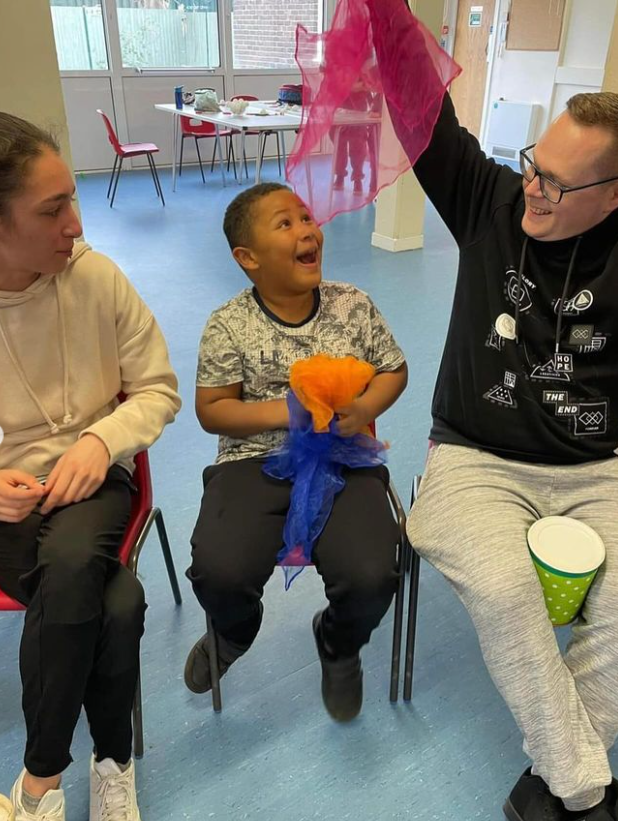
Familiarity creates opportunity
Repeated experiences of the same songs, routines, sounds and people create a predictable environment where children can choose to participate when they’re ready.
Drums were a BIG hit!
Across the project, practitioners consistently identified sticks and drums as particularly engaging.
In Bournemouth and Tidworth, our teacher observed some children playing drums for up to ten minutes at a time, exploring:
🥁 Stop and start
🥁 Loud and quiet
🥁 Fast and slow
🥁 Copying rhythms
🥁 Taking turns
🥁 Responding to someone else’s playing
A drum gives a child an immediate way to do something and communicate something, even when spoken communication may be difficult; music gives children another way to have a conversation.
Music doesn’t have to stop when the session ends; we also wanted to explore the relationship between structured music circle time and child-led play.
In short, we need both.
Music group time provides a familiar, structured routine where children can experience music together, develop shared attention, co-regulate, practise social skills and enjoy being part of a group.
But some children may choose to watch rather than join in. That’s okay; they’re still hearing the songs, becoming familiar with the routine and observing what other children are doing. They may gain confidence to join the group several weeks, or months down the line.
Whether they join the group or observe, hear the music from a distance, those musical ideas can then find their way into child-led play.
And when practitioners feel confident with music, they can recognise those little musical opportunities throughout the day.
If a child is tapping something? Tap back!
If they’re making a repeated sound? Copy it!
If they’re moving rhythmically? Add a beat!
These little musical moments can become opportunities for communication, connection and creativity.
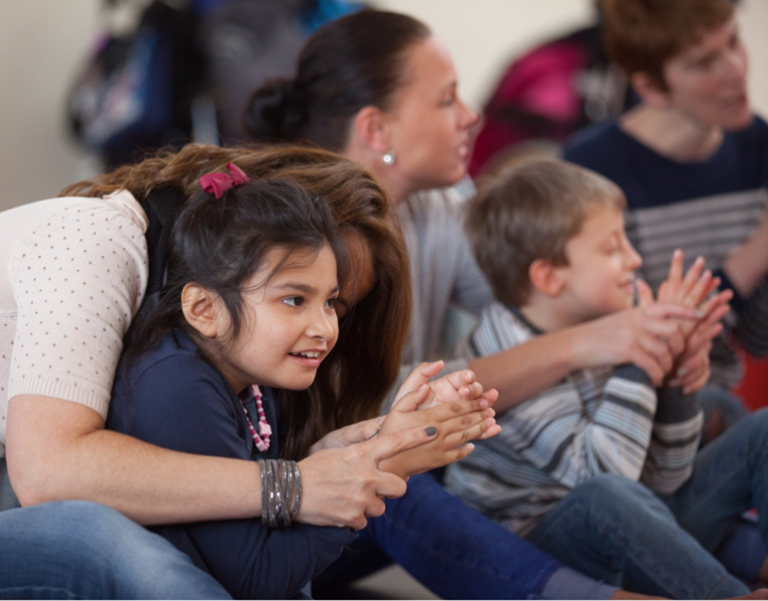
A Pedagogy of Musical Moments
Our work with Dingley’s Promise has helped us bring together four simple principles for these everyday musical moments:
Build relationships through music
Watch, listen and play alongside children. Notice what interests them and use what you discover to shape what happens next.
Be fully present and in the moment
Sometimes the best musical moment is the one you didn’t plan! Follow the child’s lead and respond to what’s actually happening.
Offer and receive
Music is a two-way conversation. We offer a song, rhythm, action or instrument. The child might join in, change it, do something completely different, or they may say, “No thanks!” And that’s okay too.
Notice and celebrate the moments
We’re often so focused on outcomes that we forget to notice the tiny moments along the way: a child making a sound, copying a rhythm, coming closer to the music circle or starting a musical interaction.
These moments matter.

And what about music at home?
Our family workshops introduced parents and carers to active music-making and practical ideas they could use with their children at home.
The feedback was lovely, with parents talking about enjoying time together, seeing their children participate and discovering new activities. All of the parents who completed the feedback form said they intended to use the activities at home.
What have we learned?
Our Dingley’s Promise project has reinforced something we already knew but has given us even more real-life examples to help us understand it: Music doesn’t have to be complicated to be powerful.
It doesn’t have to look the same for every child, and it doesn’t have to stop when the music session ends.
Sometimes it’s a whole group making music together.
Sometimes it’s one child and a drum.
Sometimes it’s a child watching from the edge of the room.
Sometimes it’s an educator noticing a tiny musical moment during play and choosing to join in.
All of those things can be music. All of them can be communication. And all of them can be opportunities for connection. They are all strengthening key cognitive connections, laying foundations for language, literacy and learning in a school classroom.
For us, the biggest learning from Dingley’s Promise is that inclusive music-making starts with knowing the child, being curious about how they communicate and being ready to respond. Regular music group time is just part of an impactful music provision in early years settings. It provides an opportunity for co-regulation, bonding and groups skills, developing shared attention and following instruction, when the children are ready for it. The music activities that spin off for from this, whether child initiated or guided one-to-one support, are just as important to make sure that children’s voices are heard.
Give children time, repetition, musical ideas and choices, give them opportunities to make music in their own way.
Most importantly equip the educators and parents who are with the children every day with music confidence, knowledge and resources that make the music part of every day for the long term.
When we fill the gap in daily music provision in early years, we make a key contribution to closing the school readiness attainment gap for all children, the impact for children with SEND has the potential to be particularly significant.


